Mobile app · fuel prices
Bak
Bak is live on the App Store in Uzbekistan: a map of fuel, gas and charging stations where drivers report the price, the stock and the queue. Free, with no ads.
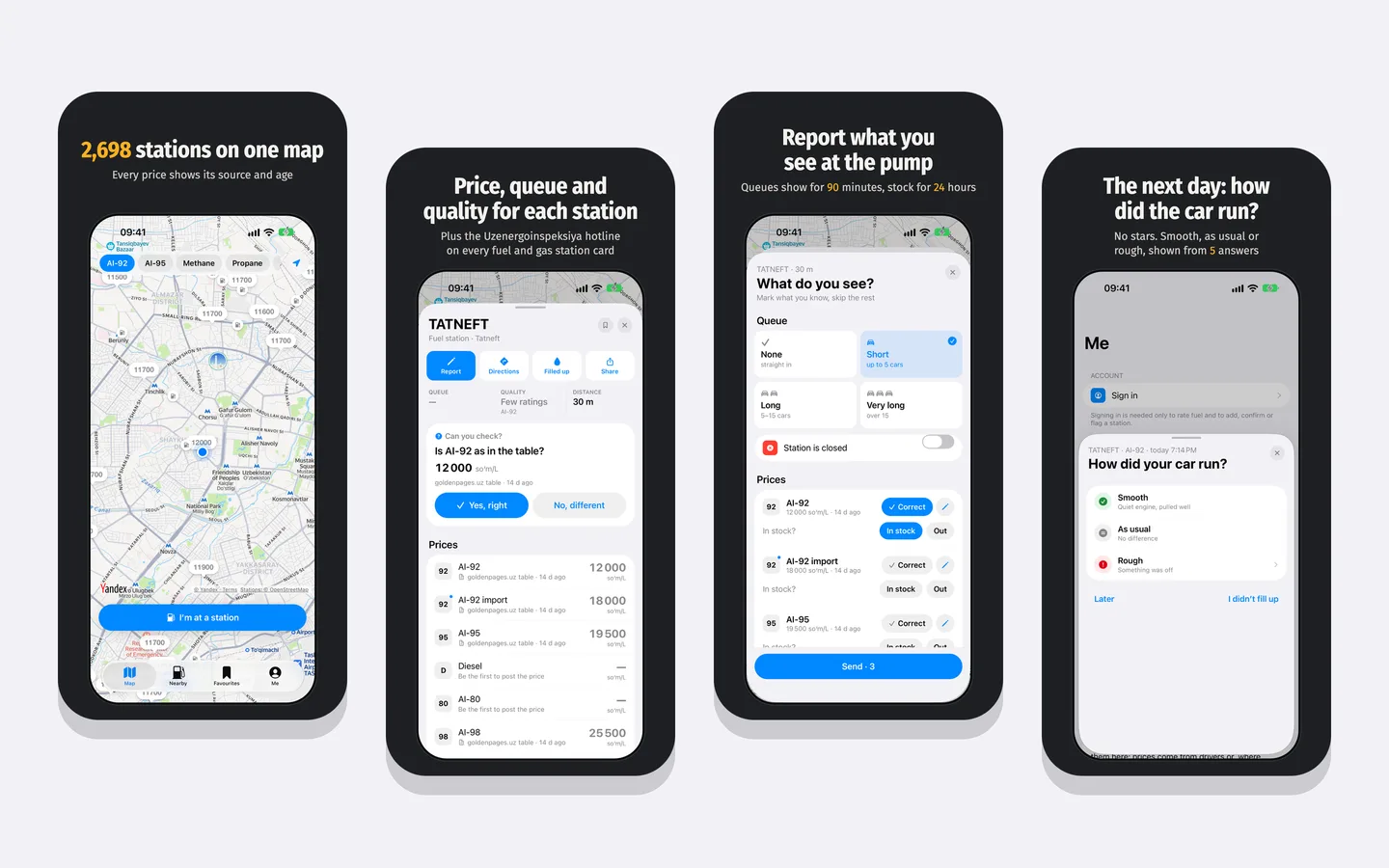
Fuel, gas and EV prices, stock and queues, reported by the drivers who are at the pump right now.
A free iPhone app for drivers in Uzbekistan: what the fuel costs at the pump, whether it is in stock, how long the queue is and, the next day, how the car ran on it. Bak is our own non-commercial product, on the App Store in Uzbekistan since 16 October 2026.
Product strategy · UI/UX design · Mobile engineering (iOS) · Database and backend
A driver learns the price and the queue only once at the station.
At the pump a driver sees what no list shows: today’s price, whether the fuel is in stock and how long the queue is.
Bak is built for that moment. It is our own non-commercial product: a driver reports in a few taps, the next driver sees it, and nobody is asked for a phone number.
Trust is written into the rules: a price waits for a second driver, and quality has no stars.
Each rule is visible to the driver: a price says when it was reported and how many different people confirmed it in the last 7 days, and while drivers disagree the card says so.
A new driver price shows as unconfirmed until a second driver gives the same number.
Stock and queue reports count only when sent within 2 km of the station; a queue is shown for 90 minutes, stock for 24 hours.
Fuel quality has no stars: about 18 hours after a fill-up the app asks how the car ran, and a station shows the answers only once there are five.
No account is needed to see or report prices; Sign in with Apple is asked only to rate fuel or change a station.
Station locations come from OpenStreetMap, with its credit on every such card; a station that drivers add and nobody confirms leaves the map after 30 days.
The same rules run in the app and in the database, and a test proves they agree.
One database holds the stations and the drivers’ reports, and the phone and the database apply the same rules to turn those reports into a station card.
- Surface
- An iOS app built with Expo and React Native
- Data
- Supabase, PostgreSQL and PostGIS
- Map
- MapLibre, with station locations from OpenStreetMap
One rule, two places, one test
The rule that turns reports into a station card runs on the phone, when the app works without a server, and in the database. It is written twice, so a test compares the two results on the same data.
A station card looks the same whether the phone built it or the database did.
Real data, labelled
Station locations come from OpenStreetMap and carry its credit. Where no driver has reported yet, the app shows a price from a published price table with its source and age, or shows nothing.
Every number on the screen has a source and a date, or it is not there.
Four language versions, one source
Uzbek in Latin is the source text; Uzbek in Cyrillic is generated from it by code, never by hand; Russian and English are written, and a test fails if a text is missing in any of them.
A new text cannot ship in one language only, and the Uzbek ʻ and ʼ are the real letters.
2,698 stations on the map: 1,483 petrol, 753 gas, 416 EV charging and 46 mixed, from OpenStreetMap data as of 10 October 2026. Source: the app’s App Store listing, read on 8 November 2026.
If an app runs on what its users report, the trust rules come before the screens.
An app that runs on what people report needs its trust rules before its screens: when a number counts, who sees what, and what is never claimed. Bak shows how we build that, and the same approach applies to an app for your customers or your staff.
Want a system like this for your business?
Describe the problem in two or three sentences. We reply the same working day and suggest a time to talk.
Reach usDiscuss your project on Telegram
- We reply the same working day, Tashkent time.
- You write to Nodirkhon; he brings in whichever of us your problem needs.